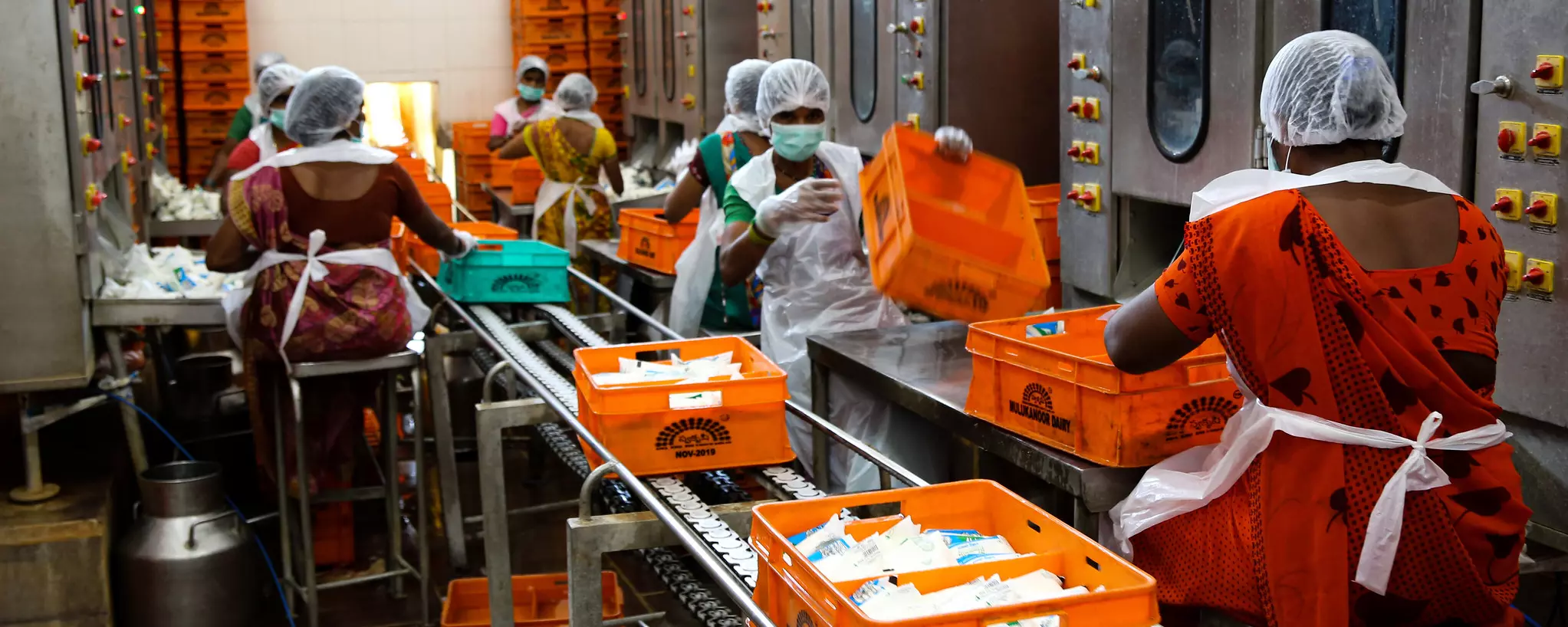
In many nations in the global South, the livestock sector is of critical national importance—but lags behind its potential. A wide range of different animals provide nutrient-rich food, income, and a financial safety net for millions of rural families.
Chickens lay eggs, cows give milk, camels transport goods, sheep and goats are eaten and skinned, oxen plough fields for crops. But they also face disease, drought, and disconnection from markets, and their productivity is frequently low. Value chains vary widely and typically involve many actors—from smallholders and pastoralists to extension agents, market actors and private companies.
Countries often want to invest more in livestock. But in which animals? At what points in the value chain? How can governments secure external funding from donors and private investors, and where can that money make the most difference? Most importantly: if you don’t know where you’re going, how will you know when you’ve arrived?
Enter Livestock Master Plans. For the past decade, the International Livestock Research Institute (ILRI) has been asked by low and middle income countries to help them to dream big—and then make a concrete plan to get there. Consulting the latest scientific evidence and using sophisticated modelling tools, ILRI scientists and their partners from the FAO, CIRAD and AU-IBAR work alongside governments to co-create a roadmap for the future of their livestock sectors.
‘Importantly, we scientists don't make a Livestock Master Plan,’ says ILRI development economist Isabelle Baltenweck.
It's the country which develops it, and ILRI and our partners support that process with our tools and our technical expertise. We’re seen as an honest broker—someone who can help national partners to look at the pros and cons of different courses of action, so they can decide how best to make the sector more efficient, more useful, more productive.
LET’S DREAM
The process always starts with a formal request from the country to ILRI. From that moment, a Livestock Master Plan typically takes around a year or 18 months to develop, and costs about a million dollars. ILRI will often work with the country to raise funds from donors to cover the cost.
Ideally, people from the private sector as well as government ministries will be involved in developing the plan, says Baltenweck, since they each have unique perspectives. ‘The private sector is very important. If they’re not aware, if we don't understand their constraints, then the plan will just remain a plan.’ Once everyone’s in the room, the first step is a visioning exercise.
The visioning is a time for us to say, let's just dream! It is big picture thinking—in the long term, where does the livestock sector need to go? What do you want to do for your country and livestock over the next 15 years? In a work environment, it's not often that we’re allowed to dream. It’s very inspiring.
A Livestock Master Plan is an evidence-based quantitative analysis of the livestock sector, says ILRI agricultural economist Sirak Bahta, which includes a baseline livestock sector analysis, a 15-year livestock sector strategy, and a five-year sector investment plan with specific, actionable steps.
To develop the baseline, the ILRI team use a modelling tool developed by CIRAD, the French Agricultural Research Centre for International Development. ‘Over the years, we’ve adjusted the tool to make it more flexible,’ says Baltenweck.
As a first step, country officials are trained to use the tool. When the best available data is plugged into it, the tool can help to reveal trends, trade-offs, and unintended consequences—which are then openly discussed among the participants. Often people surprise each other with their different perspectives, Baltenweck says. ‘It makes people have much more interesting and deep conversations than they usually have time for.’
ILRI facilitators also encourage those present to consider the implications of certain directions on women and men, and on the environment, Bahta says. ‘We’re now working on a climate tool, and it’s almost ready. We will be able to show policy makers the impact on the climate from whichever intervention they’re considering.’
INVESTING IN ETHIOPIA
The first Livestock Master Plan was drawn up by Ethiopia, beginning in 2013. Gebregziabher Gebreyohanes had just joined the Ethiopian Agriculture Ministry, as the State Minister responsible for the livestock sector. The Gates Foundation came on board to fund the process, and Gebreyohanes spent the next few years working with ILRI and his team on a livestock sector analysis—a baseline report on the current state of agricultural development in Ethiopia.
Then, they drew up a five-year Livestock Master Plan with a clear roadmap for investments from 2015-2020.
‘We wanted the Livestock Master Plan as a document to guide our policies and investments and to help us convince decision makers and the private sector,’ Gebreyohanes says. The plan identified and costed priority interventions in better genetics, feed and health services, that collectively aimed to improve productivity and production in the poultry, red-meat and dairy value chains, and ultimately reduce poverty, contribute to climate change adaptation and mitigation, and increase economic growth.
Having such a clear path forward gave the ministry confidence and helped to attract investment—from the Ethiopian Government, the World Bank, Africa Development Bank, and private international companies, says Gebreyohanes. The Bill and Melinda Gates Foundation also supported two flagship projects—the Africa Dairy Genetic Gains project and the Tropical Poultry Genetic Solutions project.
All this was meant to support the implementation of the master plan. The traditional way of planning the livestock sector, with one-off strategies—I don’t think that will attract the same kind of investment.
For instance, the LMP gave a strong signal for private investors that the country needed many more multiplication centres for chickens. ‘The government was looking for millions of day-old chicks, and that capacity was not yet in the country.’
Gebreyohanes met with the US company Ethiochicken and regional leaders from different parts of Ethiopia, and showed them the plan. The company increased production 300-fold at its existing multiplication centre in Tigray, in the country’s north, and went on to establish four more around Ethiopia. Together, they now produce 35 million day-old-chicks every year.
Ethiopia’s plan also prioritised improved genetics for the national dairy herd, and increased availability of livestock vaccines—and so the Ethiopian Government invested in four new Artificial Insemination centres, upgraded the National Artificial Insemination Centre to a Livestock Development Institute which trains AI technicians, and boosted the capacity of the National Veterinary Institute to produce more vaccines.
WE NEED A PLAN
ILRI has now drawn up Livestock Master Plans with Ethiopia, Tanzania, Rwanda, the Gambia, Uzbekistan, Nigeria and the Indian states of Bihar and Odisha. Another is currently underway in Madagascar, where the plan will prioritise addressing malnutrition in the country’s children, Baltenweck says—each plan is specifically tailored to the nation’s needs, context and priorities.
Following the development of an LMP in India’s state of Odisha in 2022, the state government boosted the budget of the Fisheries & Animal Resources Development Department from INR 4000 million to 7000 in 2024.
Improvements to the milk value chain—both cows and buffalos—and to the goat value chain were identified as priorities during the LMP process. The government is now bringing in a variety of schemes and subsidies to support farmers and small entrepreneurs, and enhance milk and meat production in a region hampered by low livestock reproductive rates, high mortality, and high disease prevalence, says ILRI agricultural economist Braja Swain, who is based in Odisha.
‘Many of the countries with an LMP are investing more in livestock, and there’s more private sector investment as well,’ says Baltenweck. ‘But we can’t yet put a number on it.’ ILRI is working on quantifying the impacts of LMPs, she says.
It’s not always smooth sailing, though. In one Indian state, ILRI scientists had worked for months with officials and the World Bank to get an LMP started. ‘We had done everything. It was all approved. There was just a signature missing, and then there was a change of government—and the whole project was cancelled.’
Gebreyohanes left the Ethiopian public service and took up a job at ILRI in 2020. The ministry there did not draw up a second five-year road-map to guide livestock activities from 2020-2024—a missed opportunity, he says.
‘It has to be revised—there will be success stories. There could be also lessons that we can learn. We might have better data now that could help us to customise and update the plan. Without checking where you are and where you want to go, then simply having a strategy will not take you far,’ he says.
‘I have a good understanding of the livestock sector in Ethiopia—I’ve worked as an extension agent, as development staff, as a policy-maker, and now a researcher at an international research institute. All that experience has convinced me that we really do need to have a livestock master plan—it has already played an important role in public and private investment in Ethiopia and the progress we’ve seen in red meat, poultry and dairy.’
Everywhere, the plans have made a difference, says Baltenweck.
‘If we are able to adjust the evolution of the livestock sector in the right direction, and right not by my standards, but by what the country wants, and you see that interventions and investments are based on what the country collectively, based on evidence, feels that they should be doing—it's rewarding,’ she says. ‘You can see that you have a direct impact on that sector, and on people’s livelihoods. It’s worthwhile.’
--
Story written by Kate Evans, science writer