Under the shade of a spreading mkuyu (fig) tree in Mmora village in Zambia’s Chiradzulu District, smallholder farmers gather to talk with extension agents and researchers from the International Livestock Research Institute (ILRI.) Women in T shirts and batik skirts sit in a circle beneath its branches, and a large rectangle of paper is pinned to the tree’s massive trunk, busy with ideas scrawled in marker pen.
This isn’t a casual chat. It’s a careful, structured conversation designed to reveal the most pressing barriers the farmers face when it comes to feeding their animals—and it’s guided by an ILRI-designed tool called the Feed Assessment Tool, or FEAST.
“It’s probably our most utilised tool and our coolest story,” says Chris Jones, who leads ILRI’s Feed and Forage Development program.
What livestock eat—and how much—is the single most important factor determining their productivity, says Jones. On smallholder farms, feed and feeding can make up 60 percent or more of a farmer’s production costs, and it’s estimated that feeding cows better could double milk production in many low-income countries.
Yet feed and forages can sometimes be overlooked in favour of other interventions, Jones says. "There's no point in having really good genetics and health interventions and then not adequately feeding the animals. There are huge opportunities for increasing the productivity, the sustainability and the resilience of livestock production in low and middle income countries by looking at feed."
In the past, governments and development organisations have often adopted a one-size-fits-all approach to interventions designed to improve animal feed, says livestock nutritionist and ILRI scientist Alan Duncan. But many interweaving factors influence both the problems farmers face and the tools, crops, and improvements they can realistically adopt.
Context matters, Duncan says, and without understanding that context, “you end up with what I call futile technologies.”
Even where the importance of feed has been recognised, the solution is not always obvious. In many rural areas, Duncan frequently sees the ruins of previous technologies donated by well-meaning outsiders—crumbling concrete urea treatment silos, hand-driven chaff-cutters too heavy for women to operate, or forage plots too small to transform locals’ lives or production.
Farmers have dutifully tried it for a year or two while the project’s there, and then when the project's gone it becomes a bit of a white elephant.
FARMERS FIRST
To overcome this problem and find out what it is that a given community actually needs, in 2009 Duncan and a handful of colleagues designed the first iteration of FEAST. “It's a simple tool, but it helps people to talk to each other in a way that brings out the problems and shows you the potential interventions that can work in that area,” says ILRI animal nutritionist Ben Lukuyu.
The tool has two components: the structured conversation with a focus group of 10-20 farmers designed to elucidate the character of the local production system and its challenges and opportunities. Then, facilitators conduct nine individual interviews representing a range of household income levels (local elders or extension agents suggest participants.) What began as a simple Excel template is now a stand-alone application, making it more robust and able to run on a wide range of computers, with a mobile phone app version currently in the works.
With the click of a button, the app generates a set of charts that show where animal feed is coming from, seasonal patterns of feed availability, herd composition, farmers’ priorities, and productivity levels. Facilitators can then prepare a report summarising the challenges and presenting some possible solutions. Crucially, researchers then report back to farmers and prioritise interventions together.
FEAST is not a magic bullet, but an essential entry point, says Duncan. “Instead of beginning with the technologies, we start with the farmers,” he says.
And not just the farmers. Those who work with farmers, like local researchers and extension agents, are a critical part of the process. They receive training in how to operate the tool and run the FEAST process, while also learning more themselves about livestock production in each place.
"We’re interested in changing their mindset, and helping them to engage a bit more meaningfully with farmers and to begin to understand the constraints that farmers face. And as a result, the kinds of interventions or solutions that we offer to farmers more closely fit the context," says Duncan.
CHALLENGING ASSUMPTIONS
Crucially, FEAST can reveal at the outset where certain interventions are likely to fail. In 2010, The International Fund for Agricultural Development (IFAD) wanted to fund a multi-million-dollar feed intervention on the Tanzanian island of Pemba. First, though, Lukuyu and his team travelled to the island and carried out the FEAST process with dairy farmers there.
The discussions quickly revealed that feed availability was the least of the farmers’ problems—access to mainland markets was their main constraint, and they already produced more milk than they could easily sell. Improving milk production through feed interventions would therefore have been a waste of time without addressing the market constraint, says Lukuyu. Instead, IFAD moved the project to a milk-deficit zone on the Tanzanian mainland. “Eventually it was more much more useful, since it was taken to a place where the locals could benefit from it more.”
In Rwanda, on the other hand, a FEAST process Lukuyu led in 2019 as part of the Rwanda Dairy Development Project led farmers and facilitators to feed interventions that are still being used today.
ILRI scientists supported the implementation of FEAST in six Rwandan districts. Partly as a result of those conversations, the project facilitators leveraged the broader experience of ILRI researchers in the research program and worked with farmers to build water tanks, animal feed stores, and cowsheds. They provided forage choppers and information manuals on growing different types of feed. They also trained farmers to make dry hay to store feed for lean seasons, how to multiply the seeds of new forage varieties adapted to each specific site, and how to access and make use of crop residues for feed.
Informal feedback from the technical team indicated that the forage introductions saved labour, especially for women, and that the interventions also improved social cohesion. And in 2022, the Rwandan Government again approached ILRI. “They said some of the things you started with that project, the farmers are still implementing,” says Lukuyu. They asked ILRI to again implement FEAST, this time in the pig value chain. The first interventions were begun in 2024.
GENDER MATTERS
In some places, it became apparent that even though women were in charge of feeding livestock, they tended to defer to men in group discussions, says Jones. “You can get different responses about what the constraints are according to whether you're asking the men or the women because of their different roles. Separating them out can be very useful for implementing changes.”
So in 2019, ILRI released G-FEAST, or gendered FEAST, with a modified focus group discussion guide and individual questionnaire designed to ensure women’s perspectives are heard and valued. It’s most useful in locations where facilitators have some expertise in gender-informed research, Lukuyu says.
It's a delicate thing, and unless you understand all those dynamics, when you come back, nothing has been done, interventions have not been adopted, because you didn't target the right people.
A WEALTH OF DATA
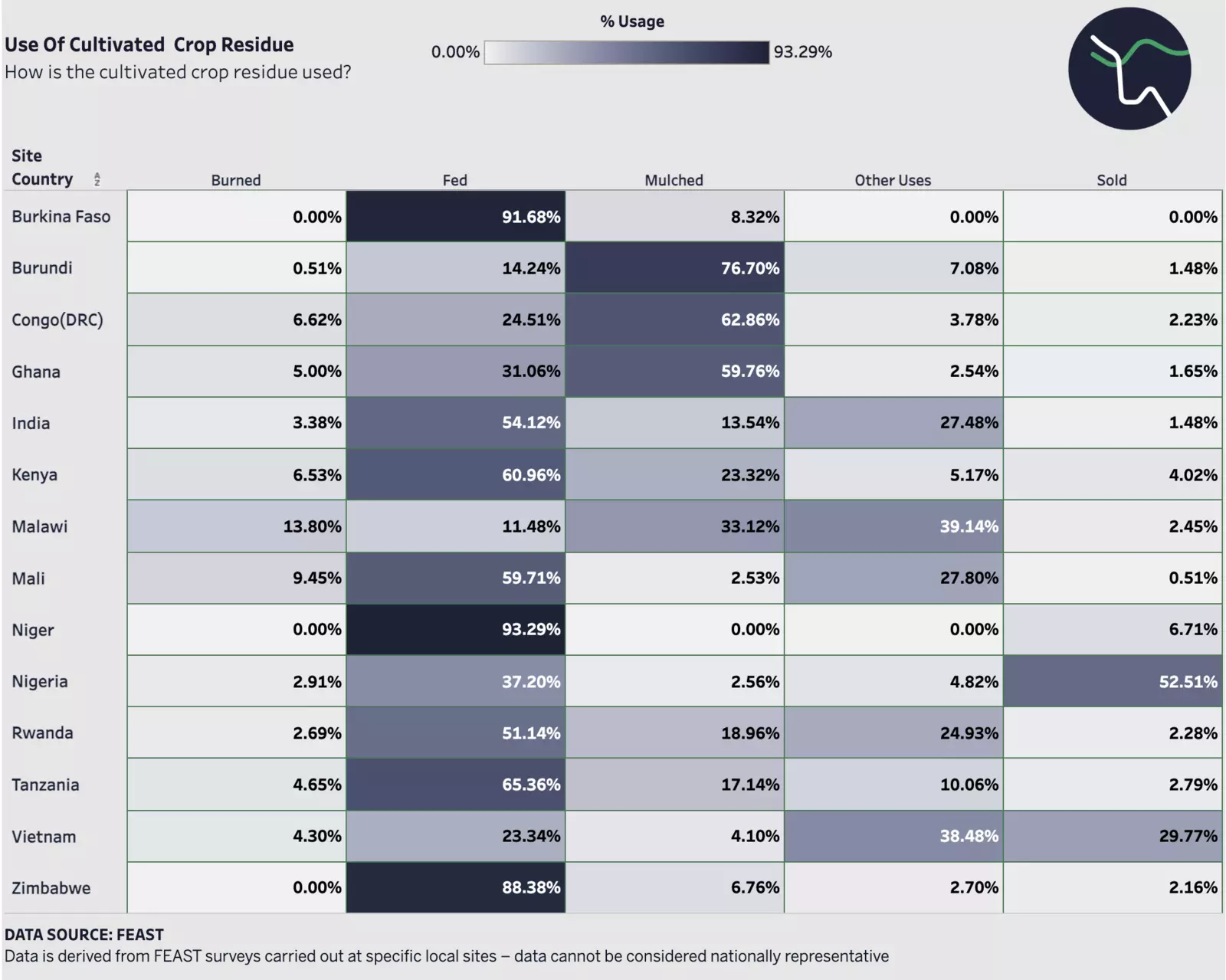
FEAST has now been used in 22 countries across Africa, Asia and Latin America, and not just by ILRI. Other organisations—including the International Center for Agricultural Research in the Dry Areas (ICARDA) in Ethiopia, non-profit Land O’Lakes Venture37 in Tanzania, and the International Institute of Tropical Agriculture (IITA) in the DRC—have also found the tool invaluable for diagnosing feed constraints and developing site-specific interventions.
Fifteen years of data collection has also resulted in an unanticipated rich resource for researchers, Duncan says—an open-source database representing livestock systems across many different parts of the world. One doctoral student, for instance, is using the database to ground-truth satellite data—with the aim of diagnosing what livestock are eating from space.
Most importantly, though, FEAST is a guided co-design process that builds relationships, trust and capacity and saves time and money. “By having this bottom-up, participatory approach you improve the chances that the interventions you are bringing in will be adopted by the farmers,” says Lukuyu.
The tool has also changed the way the researchers themselves think about the place of feed in the farming system, adds Duncan. “Applying FEAST reminds us that technical solutions are only part of the answer—we also need to think about how technical solutions fit with the market, with culture, with labour availability, with different gender roles.”
--
Story written by Kate Evans, science writer