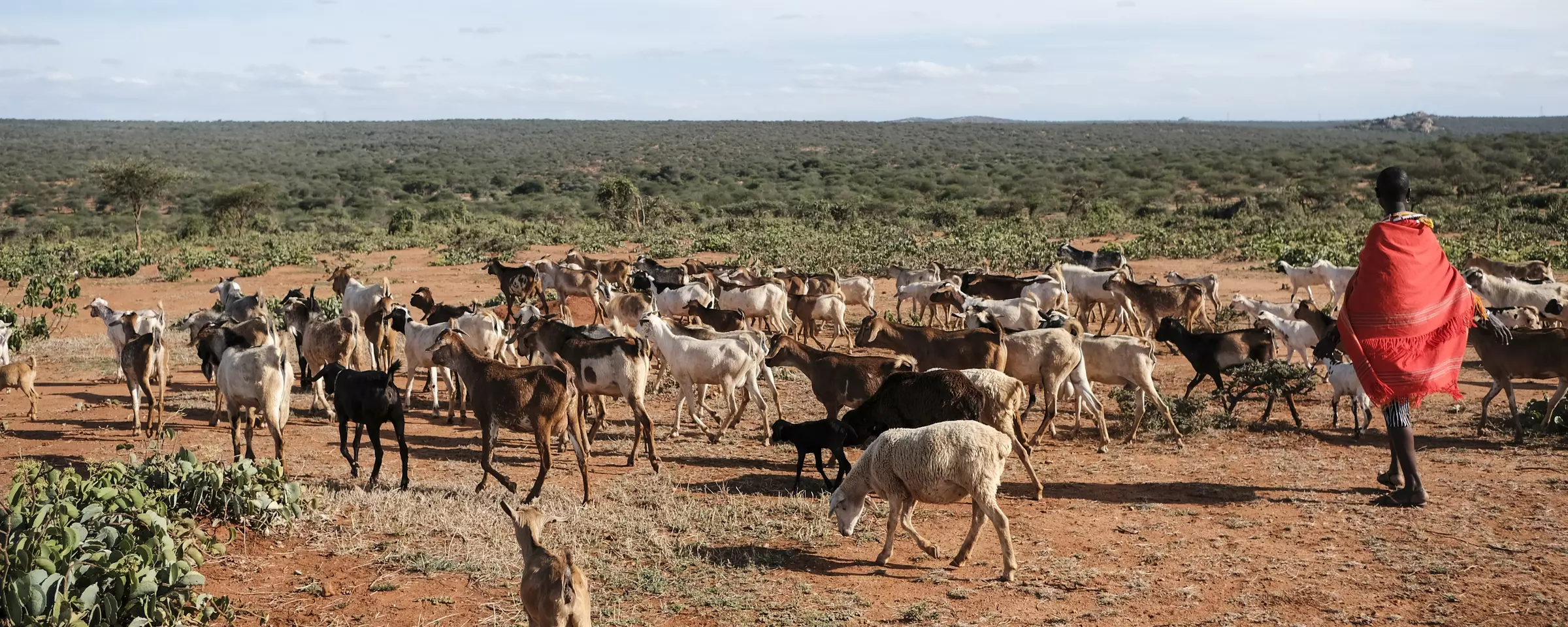
For millennia, pastoralists have moved with their herds across the Earth’s rangelands—open country grazed by both wild animals and livestock. For the vast majority of that time, pastoralism has been a flexible, sustainable, and adaptable way to make a living in dry places with variable rainfall. Today, Africa’s over 250 million livestock herders supply more than 75 percent of the continent’s milk and half its meat.
But climate change is beginning to unravel this way of life. The biggest risk pastoralists now face is repeated and prolonged extreme drought—the primary cause of livestock deaths. The Horn of Africa, for instance, suffered five consecutive poor rainy seasons between 2020 and 2022, with the March-May 2022 rainy season the driest in 70 years of record keeping.
It followed hard on the heels of previous severe droughts in 2010-11 and 2016-17—coming too often for landscapes, people and animals to fully recover, and causing interconnected complications like conflict, migration, disease, and market failure. “Pastoralism is changing,” says ILRI scientist Rupsha Banerjee. “The intensity of shocks and compounding other phenomenon is much worse than it was even 15 years ago,” she says.
But rangelands can still be very productive, she adds.
One of the most promising innovations humans have come up with to manage risk is via insurance—an ancient invention that itself dates back millennia. But until the International Livestock Research Institute (ILRI) and its partners developed the Index-Based Livestock Insurance, or IBLI, there had never been any form of agricultural insurance for dryland pastoralists—largely because of the impracticality of insurance agents travelling through remote areas to verify dead animals and pay claims.
IBLI solved that problem, and is now a powerful climate-change adaptation tool—a big idea that has evolved through many iterations since its inception and is still evolving, says Banerjee. “I don't think at any point there was any break in improving the product.”
EYES IN THE SKY
An index-based livestock insurance intervention was first trialled among the yak-herders of Mongolia in 2005. It worked like a kind of life-insurance for livestock, with payouts based on expected animal mortality rates. But collaborators from ILRI, Cornell and the University of California at Davis took a different approach. Led by then-ILRI economist Andrew Mude, the team launched IBLI in Marsabit in northern Kenya in 2010 and in southern Ethiopia in 2012.
Instead of calculating animal mortality, they utilised the Normalized Difference Vegetation Index (NDVI)—which uses remote sensing from satellites to compare the visible and near-infrared light reflected from the Earth’s surface, capturing the density of green on a patch of land and thus how much forage or fodder is available for livestock to eat.
There’s no need to prove stock losses; instead, when the green cover in a certain area pales below a threshold, indicating severe drought, the satellite data serves as a proxy for hungry or dying animals. Payouts are then automatically made to insured herders. The money can be used to buy animal feed or healthcare, meaning people can save livestock rather than sell them or watch them die. Since 2010, has supported more than 200,000 livestock herders in Kenya and Ethiopia, providing US$ 11 million in payouts and reducing both livestock distress sales and food-aid reliance by around a third.
In both countries, ILRI worked with a commercial insurance company to sell IBLI policies directly to pastoralists. In addition, in Kenya, the government’s Kenyan Livestock Insurance Program (KLIP) provided the most vulnerable herders in eight counties with IBLI insurance as a social safety-net programme.
In 2016, Mude won a prestigious World Food Prize award for his work on IBLI—and that same year, the scheme was put to the test as severe drought again struck East Africa.
In 2017, after two years of failed rainy seasons, insurance companies paid out over US$7 million to more than 18,000 herders in Kenya and Ethiopia insured through IBLI. Follow-up studies by ILRI researchers showed nearly all households invested their indemnity payments in their livestock, buying fodder, water or vet services—and as a result, fewer had to sell their animals during the crisis. Families also spent the money on food, education, ceremonies, debts, and their own medical bills.
Recognising the intervention’s promise, and inspired by IBLI, in 2022 the World Bank announced a new drylands financial services program in the Horn of Africa that aims to reach 250,000 pastoralists.
But despite the successes, there have been challenges. In the early days, pastoralists complained they weren’t receiving payouts until after their animals had already died, or the payouts were triggered when there was still plenty of fodder. ILRI then embarked on new studies to better calibrate the satellite index.
Secondly, because livestock insurance was a relatively new concept, it became clear that building the capacity and understanding of both the private sector and the pastoralists would be crucial to ensure ongoing uptake of insurance policies. Herders were unfamiliar with the idea of regularly paying insurance premiums—which may or may not lead to a payout—and many dropped out of the programs after a year or two.
On the other hand, insurance companies were reluctant to invest in marketing efforts, and complained that the distribution costs in remote pastoralist regions were far higher than the premiums they could earn. In Kenya, the only commercial insurer still active in the individual IBLI program decided to discontinue its participation in 2020, and three of the four IBLI programs in Kenya and Ethiopia have failed to make a profit.
While that’s not unexpected—“agricultural insurance across the world is subsidised”, says Banerjee—it’s sent ILRI researchers back to the field to try to figure out how to make livestock insurance an attractive option for both pastoralists and companies.
THE POWER OF BUNDLES
ILRI economist Kelvin Shikuku is now working with Banerjee in pastoralist communities in northern Kenya on a project to determine whether bundling livestock insurance with other agricultural services might be a win-win.
“As climate shocks become more severe and more prolonged, we’re asking how we can improve this product in ways that address those shocks better, but also in ways that enhance the value of insurance. When we think about affordability and sustainability, we have to look at both supply and demand,” says Shikuku.
As a first step, the team are conducting research with separate groups of men and women, using choice experiments and focus group discussions to elucidate which other products are best bundled with the insurance—“in a way that reveals truthfully what they prioritise for their context,” he says. “We’re trying to understand what kind of combinations make sense here.”
The idea is that by combining an insurance policy with, say, veterinary care, artificial insemination, or animal feeds, herders would feel they’re getting something more for their money. At the same time, those interventions would themselves increase resilience by making livestock healthier and more productive, which in turn should increase families’ income and reduce downside risk, making them more able to consistently afford insurance premiums—“demand for one service driving demand for another service,” says Shikuku.
EVOLUTION OF IBLI
Over its 15-year lifespan, IBLI has also driven significant innovation in research practice, and shaped the future and priorities of ILRI itself, says Banerjee, an expert in institutional innovation.
IBLI’s model of collaborating with the private sector for tangible welfare outcomes, as well as actively engaging in capacity-building with market players, challenged many of the accepted norms of science organisations like ILRI, says Banerjee. “It was also the first experiment of sorts to see whether a research institution can effectively work with the private sector. And not like social entrepreneurs, the hardcore private sector—insurance companies”.
It worked, and over time, the success of the highly innovative IBLI process became a trailblazer for a new kind of hybrid research and development program that delivers outcomes without compromising on science. It is now the model for several of ILRI’s partnerships and research programs—the institution evolving just as the big idea of IBLI keeps evolving, too.
“We’ve learned that IBLI cannot be used in isolation,” says Banerjee. “It needs to fit into a system, and linked to the broader livestock value chain. It can be an instrument for conflict mitigation and peace building, but we have to be intentional to make sure that IBLI does not cause unintended consequences for community cohesion or for natural resource management.
It is one of many tools that can help to build the resilience of pastoral systems, and to help them cope with climate disasters.
--
Story written by Kate Evans, science writer