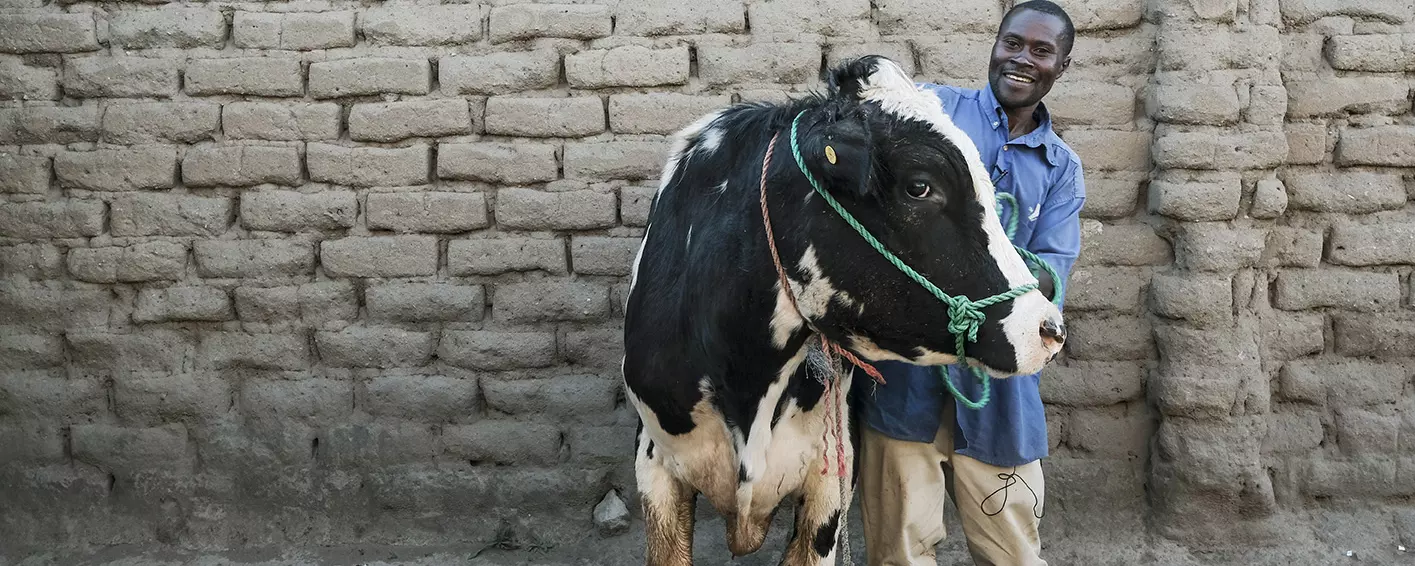
Visit a typical African smallholder’s dairy cattle herd and you’ll see what ILRI senior scientist Julie Ojango calls a 'fruit salad'. One brown, one black-and-white, one red. This one part Zebu, that one with a touch of Jersey, another a Holstein crossed with an indigenous breed. The diversity is beautiful—but the milk production often isn’t. There’s huge variation between the different breeds, and the individual cows, in terms of their genetic potential to make milk.
ILRI researchers uncovered a treasure trove of genetic traits from centuries of methodical breeding work by traditional pastoralist herders. Credit: ILRI/Annabel Slater.
Dairy powerhouses in Europe, North America and Oceania invest millions of dollars in selecting and breeding the most productive and resilient bulls and cows. As a result, milk yields in many of these countries reliably reach 25 litres per cow per day.
In Africa, however, dairy cows frequently produce just three to five litres daily. Low milk yields have cascading and widespread effects : reduced profits, poverty, and child malnourishment across the continent. These yield levels are partly the result of feed supplies, management practices, and climate—but poor genes play a significant part as well, says Ojango.
“You’ll never get as much milk as you would like unless you get the right genetics.”
Historically, authorities and farmers have tried to improve African milk production by importing proven European, North American or Australian bulls and using them to artificially inseminate local cows—the equivalent of bringing Ferraris to a region with dirt roads, in one analogy—or a sports team trained at sea level having to play at altitude. In the tropics, most of the bulls’ offspring failed to meet expectations.
A few produced plenty of milk, but it was of low quality, and too often those animals were especially vulnerable to disease. “The sort of feed that they were being given, the sort of management system that is being provided—it wasn't right for the genotypes,” Ojango says.
So a decade ago, geneticist and ILRI emeritus fellow Okeyo Mwai had an idea: to leverage the simultaneous revolutions in genomics and information technology in order to find a few needles in a country-sized haystack: strong, resilient cows and bulls with the best chance of converting the least feed into the most milk in specific environmental contexts in East Africa.
GOOD, BETTER, BEST
“If you can’t measure it, you can’t improve it,” Mwai says.
Beginning in 2011, ILRI’s Dairy Genetics East Africa (DGEA) program aimed to identify the optimum cattle breed composition for smallholder farmers in different regional environments. Researchers showed that cows with more than 65% exotic genes were better suited to more resourced farmers, while the majority of smallholders were better off with cattle that were 35-50 percent indigenous.
It quickly became clear that traditional dairy breeding programs also weren’t fit for purpose. “The initial research showed glaringly that we cannot use any conventional program to try and make a difference in these countries,” says Ojango. That’s because of the hyper-diverse ‘fruit salad’ mix of mongrel genes common in smallholder herds, which are typically tiny—often just one to three animals—and scattered over a wide area.
Data-collecting methodologies designed for homogenous herds in large-scale, well-connected production systems just didn’t make sense in many parts of Africa and other low-income regions, Ojango says. And most countries weren’t collecting any pedigree or genetic data at all.
In 2016, a follow-up effort—the Africa Asia Dairy Genetic Gains project, supported by the Gates Foundation—was underway. ILRI researchers, working with local agricultural extension agents, began collecting milk production records and hair samples from hundreds of thousands of cattle across Ethiopia and Tanzania.
Meet the farmers and scientists helping communities thrive through access to better cow breeds. Credit: Gates Foundation.
Using both genomic prediction algorithms and pedigree data, they identified cross-bred cows and bulls of exceptional genetic merit for either artificial insemination or natural breeding. (Bulls that can pass on high milk production to their female offspring were especially sought after, since a single bull can father thousands of daughters in a lifetime, whereas a cow might only have five or ten.)
By 2018, the researchers had already singled out a handful of impressive animals, and presented them to farmers at an animal expo in Tanzania—parading cows that were producing 20 litres of milk, for instance, and a bull calf whose genes showed exceptional potential. That bull now resides at the artificial insemination station at the Tanzania Livestock Research Institute (TALIRI), says Ojango.
“He’s one of the most highly demanded bulls by the farmers. They really love him—they call him the AADGG Bull.”
Since then, collaborators have tagged and registered half a million dairy cattle owned by more than 200,000 farmers in Tanzania, Ethiopia, Kenya, Uganda, Rwanda and Nepal, and collected over two million daily milk records. In Ethiopia, 70,000 doses of semen have so far been extracted from top bulls and sold at a subsidised price to farmers to inseminate their cows. “We don’t want to give it out for free—free things are not valued,” says Mwai.
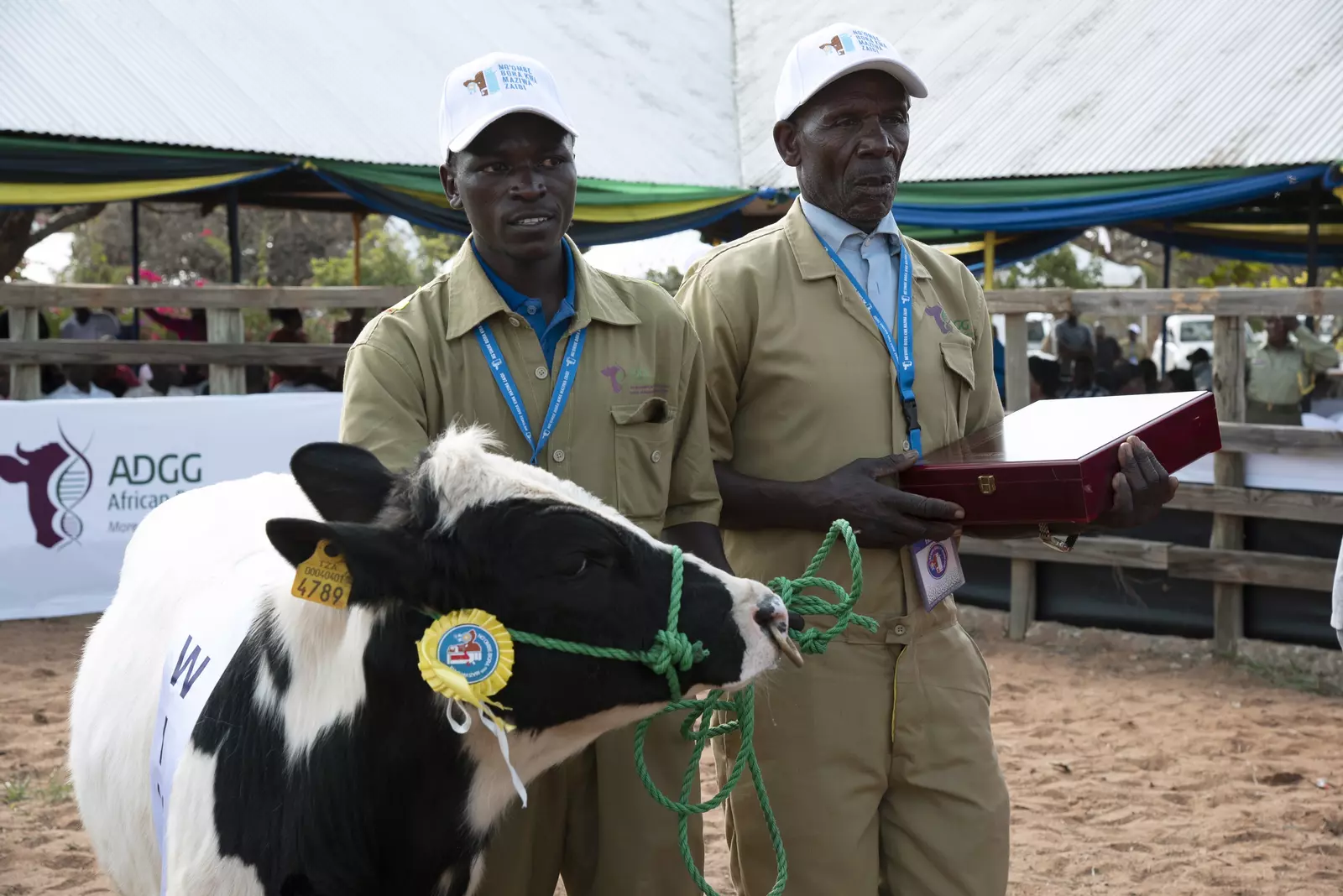
Initial results showed farmers have already seen improved milk yields of 60 percent. Much of those gains can be attributed to improved management practices, but the portion that’s genetic is cumulative—and permanent, says Mwai. “We estimate that we can have at least 2% improvement in milk yield per year. Cumulatively, that is huge. Farmers in developing countries or the tropics can identify and have access to genetics that are more productive and resilient—and that is what they need if they are going to be profitable.”
This has never been done before, says ILRI principal scientist Raphael Mrode, who leads the AADGG program. “Nobody thought that genomic prediction was feasible in a smallholder system, and we have demonstrated it—we have actually seen that it works.”
THE POWER OF TECH (and TEXTS)
The lab work is part of the story, but key to the program’s success has been its harnessing of data and communications technology.
Before AADGG, farmers had no reliable information on which bulls were best to breed from. They didn’t know how much milk they could expect from their cows, or how to increase those yields, says Mrode. But after eight years, the program has generated a huge dataset, allowing milk production records to be cross-referenced with not only genetics, but also climate and management information.
As the data bank grows, so do the possibilities. Even as farmers select certain animals that do well in their specific environment, that environment is changing. By overlaying temperature and humidity data from global weather stations, ILRI scientists can investigate which animals are likely to produce more milk under changed climate conditions.
“The variation is huge,” says Mwai. “For every increase of temperature or humidity unit, we found cows reduce their milk yield between four and twelve percent. We need to factor this in so that we can advise farmers in areas where heat and humidity is projected to rise to use bull X rather than bull Y, since its daughters will be better able to cope.”
ILRI wanted to make sure this kind of data and analysis also flowed back to the farmers, to allow them to make decisions based on evidence for their animals and their livelihoods.
Almost every home in East Africa has access to a phone, even in remote areas, Mrode says, and people are accustomed to sending money via their mobiles. In 2016, ILRI partnered with the team behind the innovative Kenyan app iCow, which distributes dairy farming advice via text messages and a helpline, leading to a 22% increase in household income for some users.
Now, all AADGG’s data is being synthesised into a cutting edge new mobile phone app, which will allow researchers to quickly inform farmers of their findings in real time and give breeding, feeding and other management advice. Farmers will also be able see how their cows’ productivity measures up against the average in their community.
Mwai hopes the two-way communication enabled by the app will also prompt a shift in scientists’ mindsets. “Don't wait until your scientific paper is out,” he advises.
Data is not important until it is transformed into knowledge, and that knowledge shared to benefit the different actors in the value chain. What can you share now that can benefit the cooperative, the milk processor, the government, or the farmer today?
A PIVOTAL MOMENT
Because calves take several years to grow up and have babies of their own, the full genetic potential of the AADGG program to boost milk yields is only now beginning to be realised. The grandchildren of the first generation of AADGG cattle are being born this year. “They are the ones that will show the genetic progress,” says Ojango. Continued funding is therefore essential, she says.
I can't stop now—it's a pivotal moment. Now I have hope that I can actually prove that genetics can make a difference.
AADGG’s benefits spiral beyond just genetics and milk production. The genomics techniques could be used to identify cows that produce high quantities of milk—but low quantities of methane, Mrode says. “Genetic factors account for around 20 percent of methane output variance.”
Additionally, the cattle identification system adopted by Ethiopia, Kenya, Rwanda and Nepal to facilitate the program will also enable governments to track the spread of diseases, animal movement, and vaccination rates, he says.
“This is groundbreaking, because at no time before has ILRI been able to directly interact with farmers with this the level of intensity,” adds Mwai.
“I see AADGG’s principles, if applied and expanded on, as the surest route for ILRI to have real and massive impact. We’ll become the go-to for low-income country information on livestock—information that is relevant and speaks to the farmers’ needs, the service providers’ needs, the policy makers’ needs.”
Knowledge is power.
--
Story written by Kate Evans, science writer